
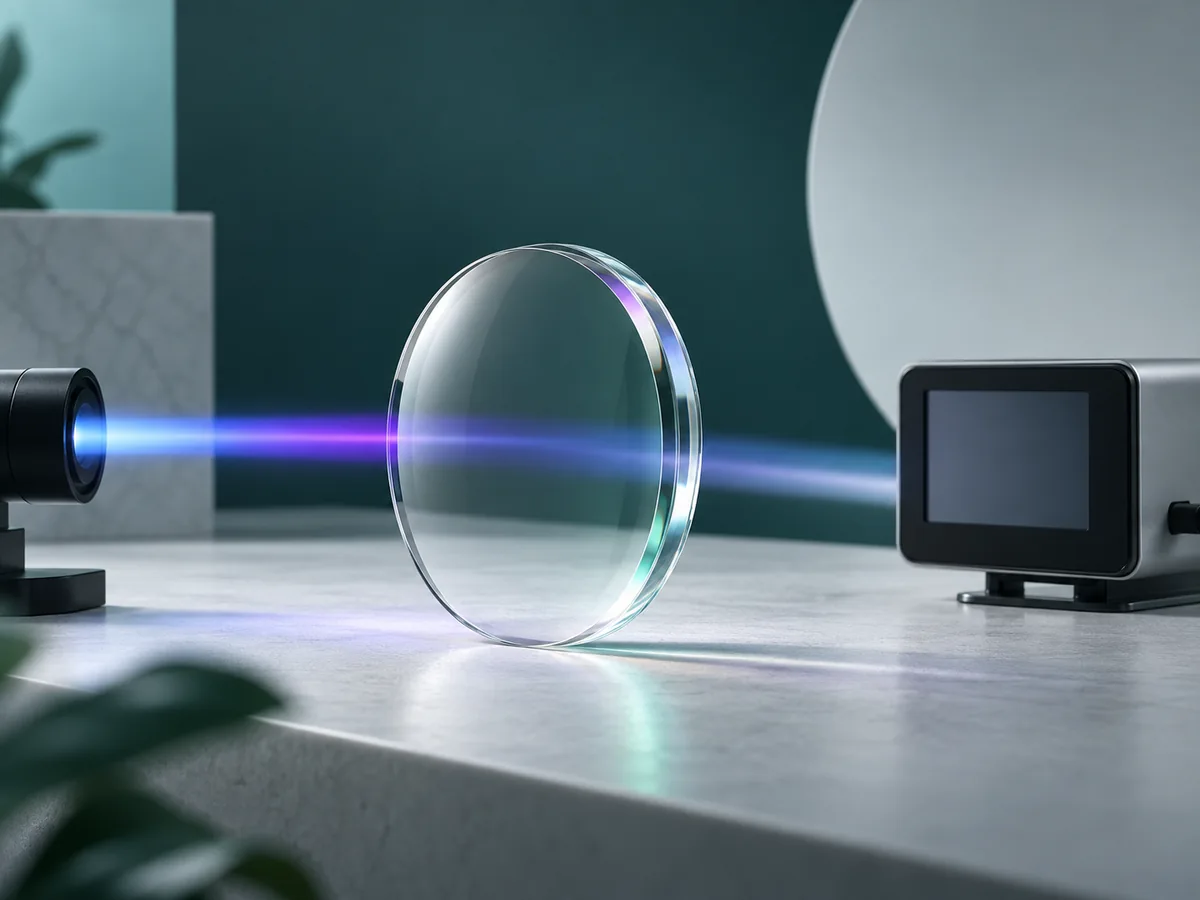
Treat UV400 and UV420 as labels that require an explicit performance definition. Ask what wavelength range is measured, which transmission limits apply and how the exact sample was tested. A reflection color, tinted appearance or a reading at one wavelength cannot describe a complete transmission curve. The quotation and report should use the same definition.
Key takeaways
- Request spectral data for the claimed wavelength range.
- Identify the material, thickness, coating and measurement conditions.
- Keep ultraviolet protection claims separate from blue-light health claims.
Why one meter reading may not answer the question
Measurement devices have different capabilities. Topcon's CL-300 specifies a UV measurement at 365 nm, while SOLOS includes spectral measurement over a broader range. This illustrates why the instrument and measurement mode matter: a single-wavelength result cannot establish performance across all wavelengths named in a claim.
Ask for the underlying report or curve with readable axes, units and the sample identifier. If a supplier sends a screen photograph, request enough context to establish what was measured before treating it as acceptance evidence.
Reference: Topcon: CL-300 lensmeter measurement functions · Topcon: SOLOS spectral and lens measurements
What should a useful report contain?
Agree the evaluation criteria before testing. A curve can be informative without automatically proving that an unspecified commercial claim has been met.
| Report item | Why it is needed | Buyer action |
|---|---|---|
| Wavelength and transmission axes | Shows the measured region and values | Check that the claim's range is covered |
| Sample specification | Connects evidence to the ordered lens | Match material, thickness and coating |
| Method and instrument | Explains measurement capability and conditions | Ask the reviewer whether it is appropriate |
| Acceptance criterion | Defines the meaning of conformity | Put the same criterion in the approved specification |
Compare two quotations without guessing
Suppose two suppliers both offer a 'UV420' option. One supplies a curve but no stated criterion; the other supplies a percentage but no wavelength range. Neither package is yet directly comparable. Send both suppliers the same clarification request rather than assuming the larger percentage describes the better product.
Keep any commercial term used on the envelope linked to the approved specification. If the lens family includes different materials or treatments, ask whether each variant is covered by the supplied evidence. Do not substitute results from an unrelated product merely because the names are similar.
- Define the claimed range and threshold.
- Confirm the exact sample and production version.
- Review both transmission data and visual appearance.
- Approve customer-facing wording from the same evidence.
Avoid turning a filter specification into a health promise
An optical transmission report measures transmission under its stated conditions. It does not, by itself, establish treatment of eye disease, prevention of retinal damage from ordinary screens or relief of every user's discomfort.
Use factual, product-specific language about the measured property. If a customer asks about symptoms or medical benefits, direct the question to an eye-care professional and the relevant clinical evidence rather than extrapolating from a filter label.
Buyer questions
Frequently asked questions
Does a blue reflection prove UV420 performance?
No. Surface reflection color is not a substitute for wavelength-resolved transmission evidence.
Can a 365 nm reading verify the entire UV400 or UV420 claim?
No. It describes one measurement point, not the complete region or acceptance criterion.
Is a UV420 lens automatically suitable for every customer?
No. Product choice also involves prescription, visual requirements, appearance and professional fitting advice.
Further reading
These external references provide background context. Product availability and performance claims must still be confirmed for the exact item being purchased.