
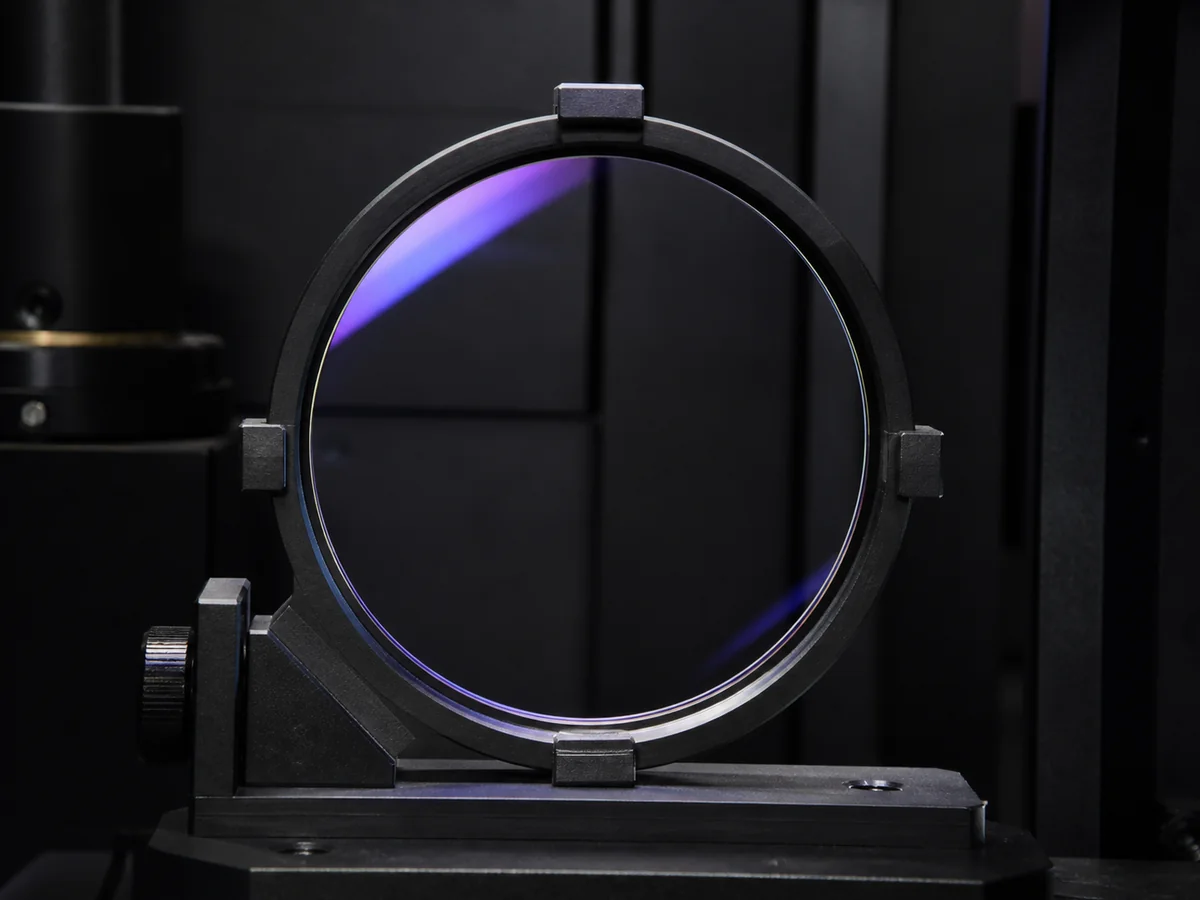
Blue cut, blue filter, blue block, and UV420 are common commercial descriptions, but they do not provide a complete spectral specification. A buyer should not approve a lens from the product name or reflected coating color alone. The useful evidence is a transmission curve, a defined wavelength range, a measurement method, and an approved sample that matches the final material and coating.
Key takeaways
- Blue cut is a broad commercial category rather than one universal transmission curve.
- UV420 is commonly used to describe filtering extending toward 420 nm, but the required threshold and measurement conditions must be stated.
- A blue or violet surface reflection does not prove substrate absorption or total spectral performance.
- Avoid unsupported health, sleep, or eye-fatigue claims in product marketing.
Why the names are easy to confuse
A lens can reduce selected short-wavelength transmission through the lens substrate, through a surface coating, or through a combination of both. Different constructions can produce different lens color, residual reflection, visible-light transmission, and spectral curves while using similar marketing names.
UV protection and blue-light filtering also cover different parts of the spectrum. A buyer therefore needs to define the required measurement range instead of assuming that 'blue cut' automatically means a particular UV or 420 nm result.
Compare specifications, not labels
Use the supplier's name to identify the program, then qualify it with a controlled data sheet and sample.
| Question | Blue-cut listing | UV420 listing | Recommended evidence |
|---|---|---|---|
| What is filtered? | Selected blue-violet range | UV and near-violet range described around 420 nm | Full spectral transmission curve |
| How is it achieved? | Substrate, coating, or both | Often substrate absorption, coating, or both | Material and layer construction statement |
| What does reflection color prove? | Appearance only | Appearance only | Do not use color as the spectral test |
| What should be approved? | Curve, clarity, color, coating | Curve, clarity, color, coating | Test report plus physical sample |
Data to request before quotation
Request the same data for the sample and bulk-order material. A report from a different index, substrate, or coating may not represent the product being purchased.
- Lens material, refractive index, and clear or photochromic state
- Spectral transmission curve with wavelength axis and transmission percentage
- Defined cut-off, blocking, or transmission target and how it is calculated
- Visible-light transmission and any acceptable base tint
- Coating type, residual reflection color, and surface treatment
- UV test requirement for the destination market
- Instrument, measurement method, sample condition, and report date
- Representative powers, diameter, packaging, and approved label wording
Be careful with consumer-facing claims
Professional bodies have reported that current evidence does not support broad claims that blue-blocking spectacle lenses improve visual performance, relieve eye strain, improve sleep quality, or protect macular health in the general population. Wholesale buyers should review destination-market advertising rules and avoid turning a spectral feature into an unsupported medical promise.
A safer product description explains what is measured: material, wavelength range, transmission behavior, coating, lens color, and test conditions. This is clearer for distributors and easier to verify during repeat orders.
Sample approval checklist
Check optical power and cosmetic quality first, then compare base tint, reflected color, clarity, and spectral data. Ask whether the test report corresponds to the exact index and coating received. Keep one approved pair as the visual reference and record the report version in the purchasing specification.
For a multi-index range, do not assume one curve represents every material. Qualify the 1.56, 1.60, 1.67, polycarbonate, photochromic, or other variants that will actually be sold.
Buyer questions
Frequently asked questions
Is every blue-cut lens a UV420 lens?
No. Commercial names vary, and blue-filter performance does not define one universal UV or 420 nm curve. Request the spectral specification.
Does a blue reflection prove blue-light blocking?
No. Residual reflection color is not a substitute for a transmission measurement through the complete lens.
Can one test report cover every refractive index?
Not safely by assumption. Confirm that the report identifies the same substrate, index, coating, and product configuration being purchased.
Further reading
These external references provide background context. Product availability and performance claims must still be confirmed for the exact item being purchased.