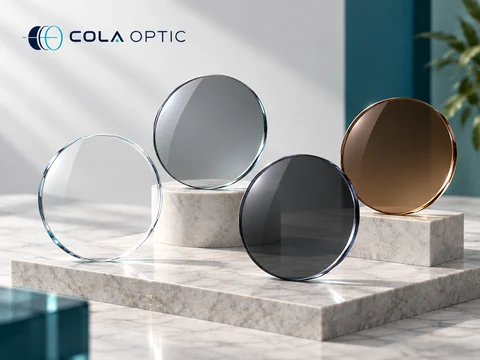
Material-based and spin-coated light-adaptive lenses with color and design choices.
Programs listed2
Supply routeStock & RX inquiry
Buyer responseWithin 1 business day
Category guide
Choose the activation route and color program.
Material-based and surface-coated photochromic lenses are distinct product routes. Compare clear state, activated color and fading under agreed conditions for the exact product.
Open a product below for specification tables and its illustrated design guide. Send the matrix, quantity and destination so material, availability, testing and packaging can be confirmed in one quotation.
Available programs
Compare photochromic lenses.
Open a product page for detailed parameters, sample checks, customization options, and procurement FAQs.
Material-based photochromic options covering single vision, bifocal and progressive designs. Choose clear-base or blue-filter configurations and approve the desired activated color under defined conditions.
Single vision / bifocal / progressiveClear-base and blue-filter optionsGrey, brown and color inquiries
A spin-coated photochromic family with clear-base and blue-filter options. Index, diameter, color and specialist in-car or abrasion-resistance requirements are specified as distinct configurations.
Surface photochromic layer1.56 / 1.57 / 1.60–1.61 / 1.67 / 1.74 inquiriesGrey and brown core colors
A focused specification makes supplier comparison, sample approval, and repeat purchasing more reliable.
Design and materialIdentify the lens design and exact substrate rather than relying on a general category name.Prescription and dimensionsProvide sphere, cylinder, addition where relevant, diameter and fitting requirements.Performance and appearanceAgree test criteria and retain approved samples for color and surface comparison.Commercial scopeConfirm quantity, minimum order, delivery, labeling and market documentation.
Procurement reference
What to include in your inquiry.
Final availability, tolerances, testing, packing, and commercial terms are confirmed against the approved product specification.
Photochromic Lenses procurement specification
Parameter
Requirements
Product programs
By Material / By Spin Coating
Supply route
Stock & RX inquiry
Order unit
Define pieces, pairs or matched RX jobs explicitly
Sample approval
Product identity, optical parameters, dimensions, appearance and packing
Repeat orders
Use the approved specification and artwork revision
Buyer applications
Programs built for professional optical supply.
Material photochromicSpin-coated photochromicGrey and brownAdditional colors by inquiry
Category FAQ
Questions buyers ask before requesting samples.
Which photochromic lenses programs are listed?+
By Material, By Spin Coating. Each product page explains its own configuration.
What is needed for a quotation?+
Send the selected product, material or index, prescription matrix, diameter, coating, quantity and destination market. Add fitting information for designs that require it.
Is every combination and quantity immediately available?+
No. The final matrix, minimum quantity, lead time and required evidence are confirmed in the quotation and sample approval.
Request a focused quotation
Send the specification, quantity, and destination market.
We will review the product route, representative samples, packaging requirements, and information needed for a repeatable order.