
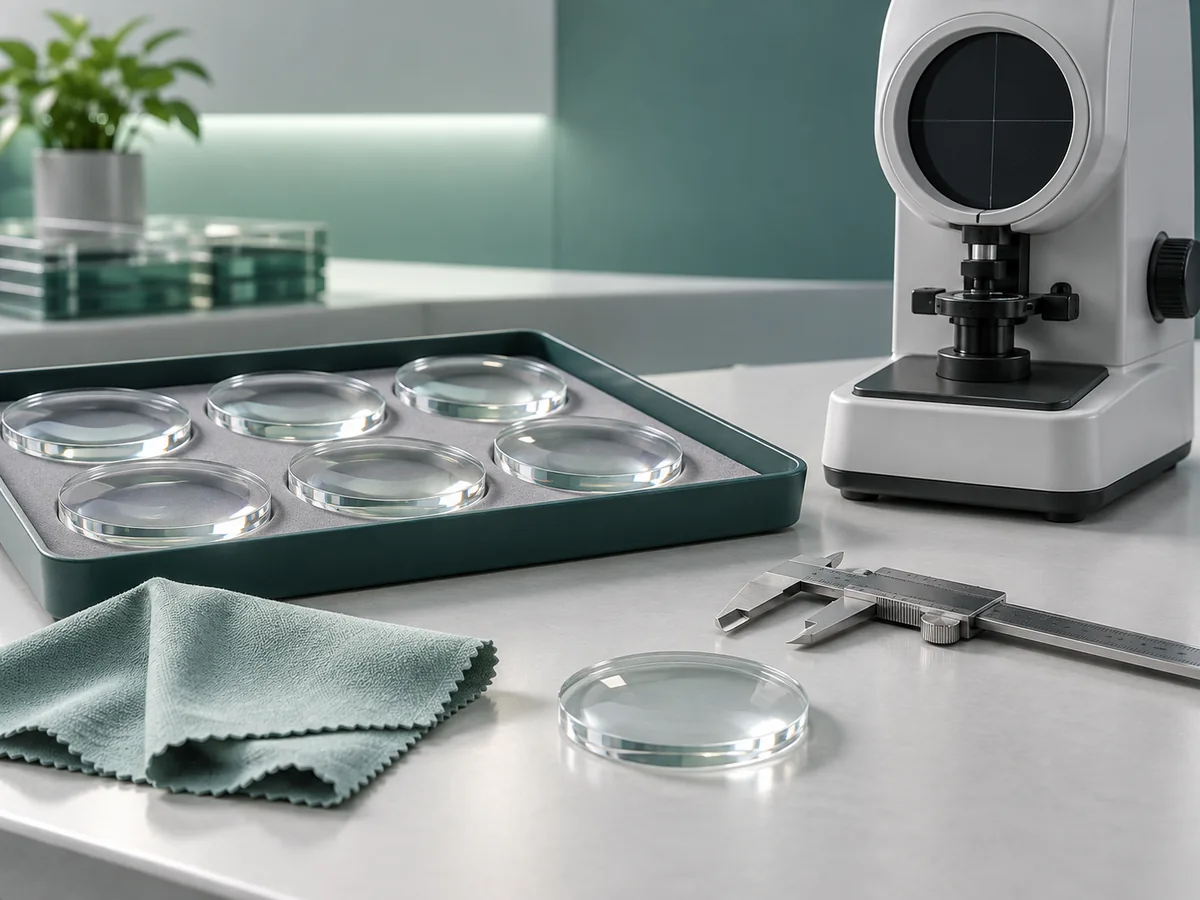
A useful optical lens sample inspection starts with the agreed specification and records a separate result for identity, optics, dimensions, appearance and packaging. It should state who measured what, by which method and against which criterion. Sample approval helps qualify a product; it does not automatically accept every future production lot.
Key takeaways
- Agree acceptance criteria before the samples arrive.
- Keep measured results separate from visual observations.
- Retain sample identity and a clear approval decision.
Prepare the inspection record first
ZEISS describes multiple optical and dimensional checks in lens manufacturing. For a buyer, the practical lesson is to review several relevant properties rather than relying on one attractive sample photograph.
Create a record with supplier, sample ID, product revision, batch where available, date and inspector. Attach the quoted specification. If a requirement has no agreed criterion, mark it as unresolved instead of silently inventing a pass threshold during inspection.
Reference: ZEISS: How spectacle lenses are manufactured
Use a layered checklist
The exact methods and tolerances depend on the supplied product and applicable requirements. Have competent technical staff choose and perform the measurements.
| Layer | Examples of checks | Record type |
|---|---|---|
| Identity | Material, design, coating, power and label match | Specification reconciliation |
| Optics | Relevant sphere, cylinder, axis, addition or prism checks | Measured values and method |
| Dimensions | Diameter and relevant thickness or geometry | Measurements and locations |
| Appearance | Surface condition, reflection or tint matching | Observation under agreed conditions |
| Packaging | Protection, quantity and label readability | Photo and count record |
Make the sample set representative
Ask the technical team to choose samples that cover the intended range and meaningful variations. A single moderate-power sample cannot establish that every diameter, coating and boundary combination is suitable. Record what the sample set covers and what still requires confirmation.
For an illustrative approval, a distributor might approve the inspected coating appearance while holding one diameter pending a cutout trial. Write that partial decision explicitly. A vague email saying 'samples look good' can be misread as approval of the entire order.
- Identify every sample before handling.
- Use appropriate equipment and its required checks.
- Record deviations even when the final decision is acceptance.
- Retain an approved reference sample where useful.
Separate qualification from lot acceptance
After product approval, agree how production lots will be inspected and what happens when a discrepancy is found. Define lot identity, sampling approach, acceptance criteria and escalation responsibility with the quality team. There is no universal sample count that fits every order.
For a failed check, preserve the sample and record the evidence before requesting replacement or investigation. Track the corrective response and any revised specification. Future purchasing decisions are more useful when based on documented outcomes than on a general impression of sample quality.
Buyer questions
Frequently asked questions
Does sample approval guarantee every bulk shipment?
No. Product qualification and production-lot acceptance serve different purposes and need their own controls.
How many samples should we inspect?
Agree a plan with the quality team based on the product, variations, risk and applicable requirements; do not use one arbitrary count for all orders.
Can visual inspection replace lens measurements?
No. Appearance checks and optical or dimensional measurements answer different questions.
Further reading
These external references provide background context. Product availability and performance claims must still be confirmed for the exact item being purchased.