
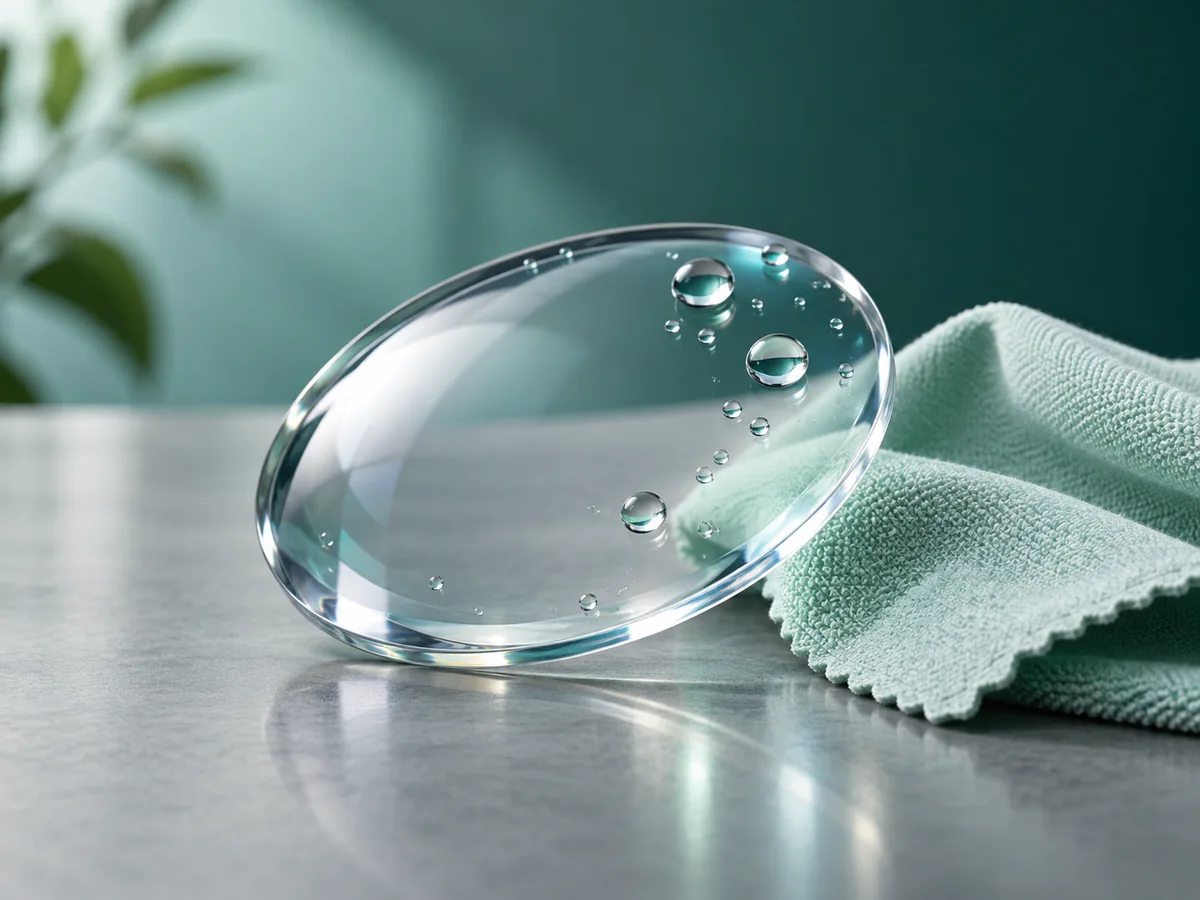
Hydrophobic describes resistance to wetting by water; oleophobic concerns oil. Neither term alone defines how easy a finished lens will be to clean throughout use. Buyers should ask for the coating system, test method, acceptance criteria and any conditioning used before measurement. Cleanability claims are most useful when tied to a repeatable comparison.
Key takeaways
- Water beading does not prove oil repellency or long-term durability.
- Define the cleaning procedure and inspection conditions before testing.
- Approve the complete coating stack and its processing compatibility.
Why the two properties should stay separate
ZEISS describes water- and oil-repellent surface features as parts of a lens coating system. They address different interactions with the surface and should not be treated as interchangeable labels.
A dramatic water-droplet photograph can illustrate the idea, but it does not provide a measured contact angle, resistance to repeated cleaning or proof of scratch resistance. Ask which property the supplier's demonstration actually supports.
Reference: ZEISS: Spectacle lens coatings
Translate a marketing term into a specification
Start with the practical problem you want to compare, then choose a suitable test with the supplier or laboratory. Avoid inventing acceptance thresholds after seeing the results.
| Property | Clarification to request | Record to retain |
|---|---|---|
| Water repellency | Method, conditions and acceptance criterion | Measured result for the identified sample |
| Oil-related cleanability | Contaminant and cleaning procedure | Before-and-after assessment under agreed conditions |
| Durability | Conditioning or cycling before reassessment | Procedure and result after conditioning |
| Processing | Compatibility with handling and edging | Laboratory approval for the coating system |
Run a comparison that can be repeated
Use identified sample pairs and the same cleaning materials. Record the contamination procedure, contact time where relevant, cleaning steps and inspection setup. Let the testing professional choose an appropriate method; an informal demonstration should remain labeled as such.
As an illustrative acceptance exercise, compare a new coating against the retained approved sample using the same procedure. Keep initial results separate from results after agreed conditioning. A strong initial result and a weak conditioned result answer different questions and should not be merged into one score.
- Record sample and coating revision.
- Use consistent cloths, liquids and handling.
- Inspect under the same lighting.
- Keep observations and measured results clearly distinguished.
Agree care instructions and change control
Ask for cleaning and handling instructions that match the supplied product. Do not invent chemical-resistance claims or recommend aggressive cleaners without product-specific approval. Distributor staff should give customers the same approved instructions that accompanied the selected coating.
When a supplier changes the topcoat, review both performance evidence and laboratory handling. A similar trade name or reflection color does not establish that the revised coating behaves identically. Keep the old and new references distinguishable in purchasing records.
Buyer questions
Frequently asked questions
Does a hydrophobic coating stop every fingerprint?
No. Water repellency does not establish resistance to oils or all forms of contamination.
Does an easy-clean coating make a lens scratch-proof?
No. Cleanability and abrasion resistance are separate properties, and absolute scratch-proof claims should be avoided.
Can a water-drop photo serve as our acceptance test?
It can support a visual discussion, but formal acceptance needs an agreed procedure, identified samples and defined criteria.
Further reading
These external references provide background context. Product availability and performance claims must still be confirmed for the exact item being purchased.