
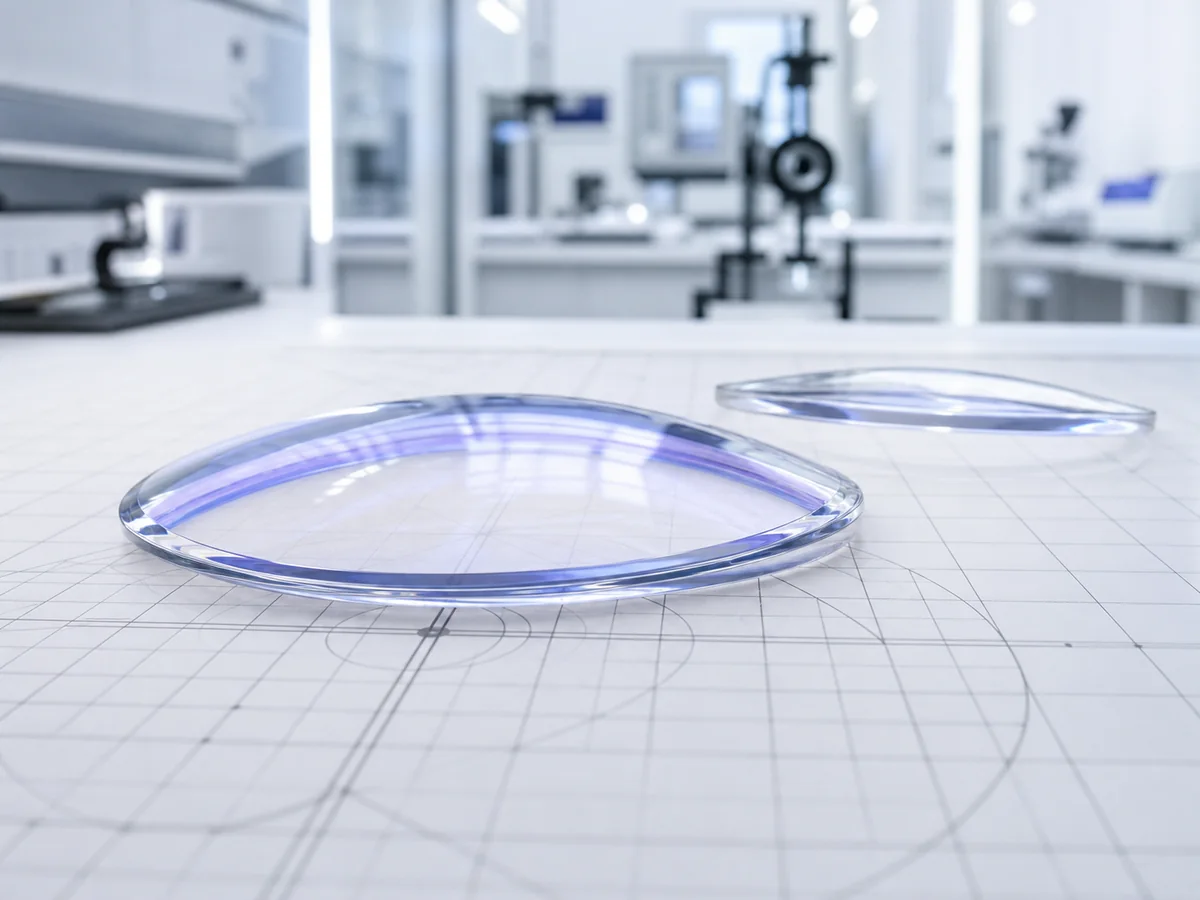
Spherical and aspheric describe lens surface design, not lens material or coating. A spherical surface follows one constant radius. An aspheric surface changes curvature progressively from the center toward the edge. That additional design control can support a flatter profile and improved off-axis performance, but the result still depends on power, material, diameter, frame data, and the supplier's design.
Key takeaways
- Design and refractive index are separate choices: both spherical and aspheric lenses can be offered in several materials.
- Aspheric designs can be flatter and cosmetically thinner, with the effect often more visible in plus powers.
- The word aspheric does not identify one universal design or performance level.
- Compare samples using the same prescription, index, diameter, and coating.
How the surfaces differ
A conventional spherical lens uses a surface whose curvature is based on a sphere. It is straightforward to manufacture and remains a practical option for many standard-power programs.
An aspheric surface changes curvature across the lens. The design can reduce selected off-axis aberrations and allow a flatter form. The actual optimization is product-specific, so branded performance figures should not be applied to every generic aspheric lens.
Wholesale comparison
Use design as one row in the product matrix rather than treating it as a replacement for the complete specification.
| Item | Spherical | Aspheric |
|---|---|---|
| Surface form | Constant spherical curvature | Curvature changes across the surface |
| Typical positioning | Standard, value-oriented programs | Flatter-profile or upgraded programs |
| Thickness potential | Depends on material and geometry | Can reduce center thickness in plus powers and improve profile |
| Information required | Power, diameter, base curve, index | Power, diameter, design, index, fitting assumptions |
Why a fair sample comparison matters
An aspheric 1.60 lens should not be compared with a spherical 1.56 lens and then attributed entirely to design. Material index, center or edge thickness rules, diameter, base curve, and coating can all change the result.
Request matched samples in representative plus and minus powers. Measure center thickness for plus lenses, edge thickness for minus lenses, and check cosmetics and usable field through the intended frame geometry.
What to include in the inquiry
A concise design inquiry should make the expected product tier and comparison conditions clear.
- Spherical or named aspheric design
- Material and refractive index
- Sphere and cylinder range
- Available diameters by power band
- Minimum center or edge thickness rules
- Base curve and frame compatibility where relevant
- Coating and spectral requirements
- Matched sample powers for approval
Buyer questions
Frequently asked questions
Is every aspheric lens thinner than every spherical lens?
No. Aspheric design creates thickness and profile advantages under selected conditions, but index, power, diameter, and minimum-thickness rules also control the result.
Is aspheric the same as high index?
No. Aspheric describes surface design; high index describes the lens material's refractive index.
Should a wholesale range contain both designs?
It can. A spherical tier can serve standard demand while an aspheric tier provides a flatter-profile upgrade, provided the ranges are clearly separated.
Further reading
These external references provide background context. Product availability and performance claims must still be confirmed for the exact item being purchased.