
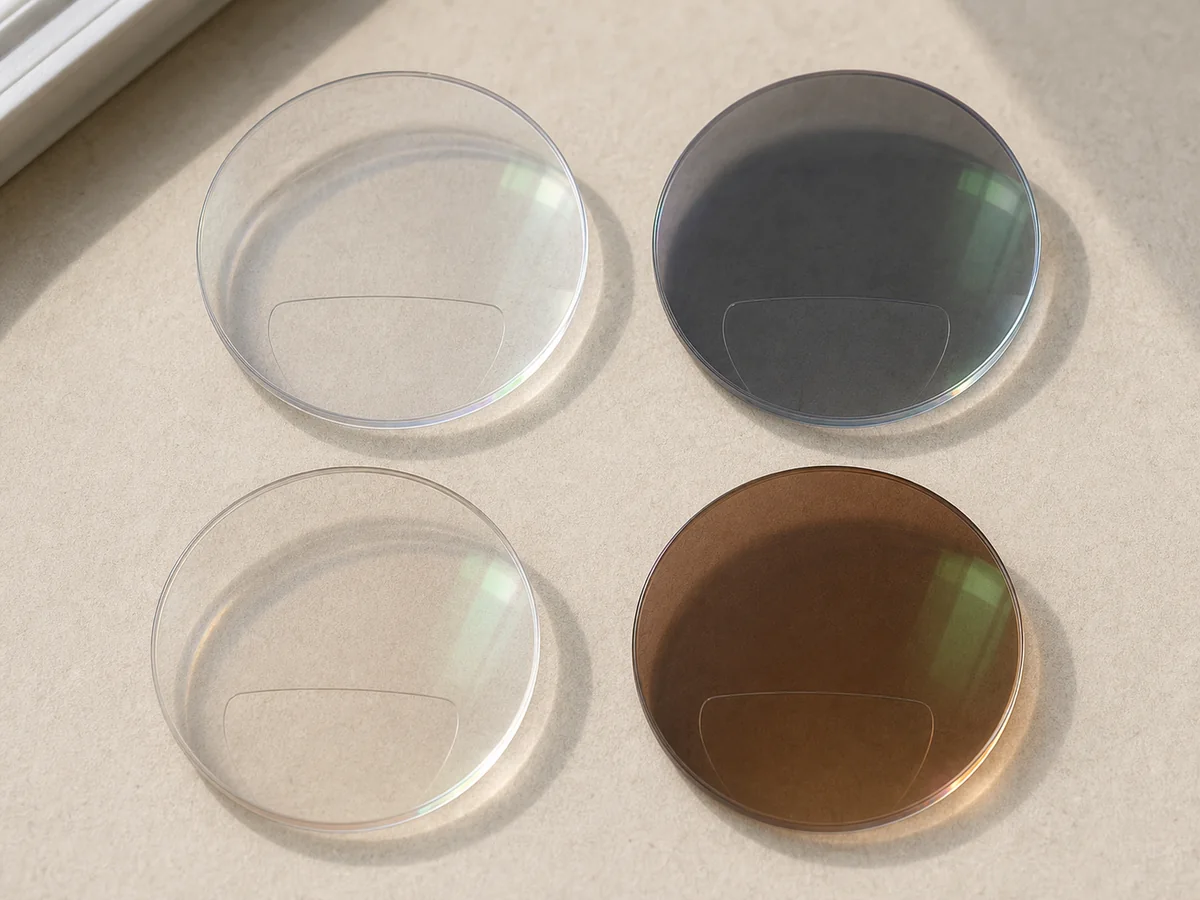
Grey and brown are the two most familiar photochromic color families, but color preference alone is not enough for a wholesale specification. Activation darkness, fade-back behavior, indoor residual tint, temperature, ultraviolet exposure, lens material, thickness, coating, and test method can all change what the buyer sees. The approved sample and test conditions should therefore be recorded together.
Key takeaways
- Grey and brown identify color families, not one fixed transmission or activation result.
- Photochromic performance is influenced by temperature, UV exposure, lens material, and product generation.
- Approve clear state, activated state, color consistency, and fade behavior under defined conditions.
- Do not use one plano sample to qualify every index, power, thickness, and coating.
Color is only one part of performance
Grey is commonly selected for a neutral-looking darkened appearance, while brown creates a warmer appearance. These are product-positioning differences, not proof that one color is universally better.
Two grey products can differ from each other as much as a grey and brown product if their chemistry, material, coating, temperature, and exposure conditions differ. For purchasing, compare measured transmission and controlled samples rather than color names alone.
What to compare
Ask the supplier to state the test conditions whenever activation or fade times and transmission values are quoted.
| Review point | Grey program | Brown program | Approval method |
|---|---|---|---|
| Indoor state | Clear to residual grey tint, product-dependent | Clear to residual warm tint, product-dependent | Transmission data and neutral-background sample |
| Activated appearance | Neutral grey family | Warm brown family | Controlled UV activation and visual reference |
| Darkness and fade | Depends on product and conditions | Depends on product and conditions | Time, temperature, UV source, and measurement interval |
| Range consistency | Check each material and thickness | Check each material and thickness | Representative powers from the actual matrix |
Why test conditions matter
Photochromic molecules respond to light and their behavior can vary with temperature. Supplier values measured at one temperature or exposure cycle should not be presented as universal real-world results.
Request the activation light source, irradiance or stated method, temperature, exposure time, transmission measurement points, and fade-back endpoint. For repeat orders, use the same method and an approved physical reference where practical.
Wholesale inquiry checklist
Define the color together with the complete lens construction and required data.
- Grey or brown color family and approved sample code
- Material, refractive index, and lens design
- Finished or semi-finished supply format
- Power, diameter, base curve, and thickness matrix
- Indoor and activated luminous transmission targets
- Activation and fade test conditions
- Coating, residual reflection color, and UV requirement
- Color matching tolerance, packaging, and traceability
Buyer questions
Frequently asked questions
Is grey photochromic always darker than brown?
No. Darkness is product- and test-condition-specific. Compare transmission data for the exact grey and brown programs.
Why can the same photochromic lens look different in two tests?
Temperature, UV source, exposure time, lens material, thickness, and viewing background can all affect the observed result.
Can a plano sample approve the full prescription range?
It is useful as a first reference, but representative powered samples should be checked because material thickness and construction can affect appearance.
Further reading
These external references provide background context. Product availability and performance claims must still be confirmed for the exact item being purchased.