
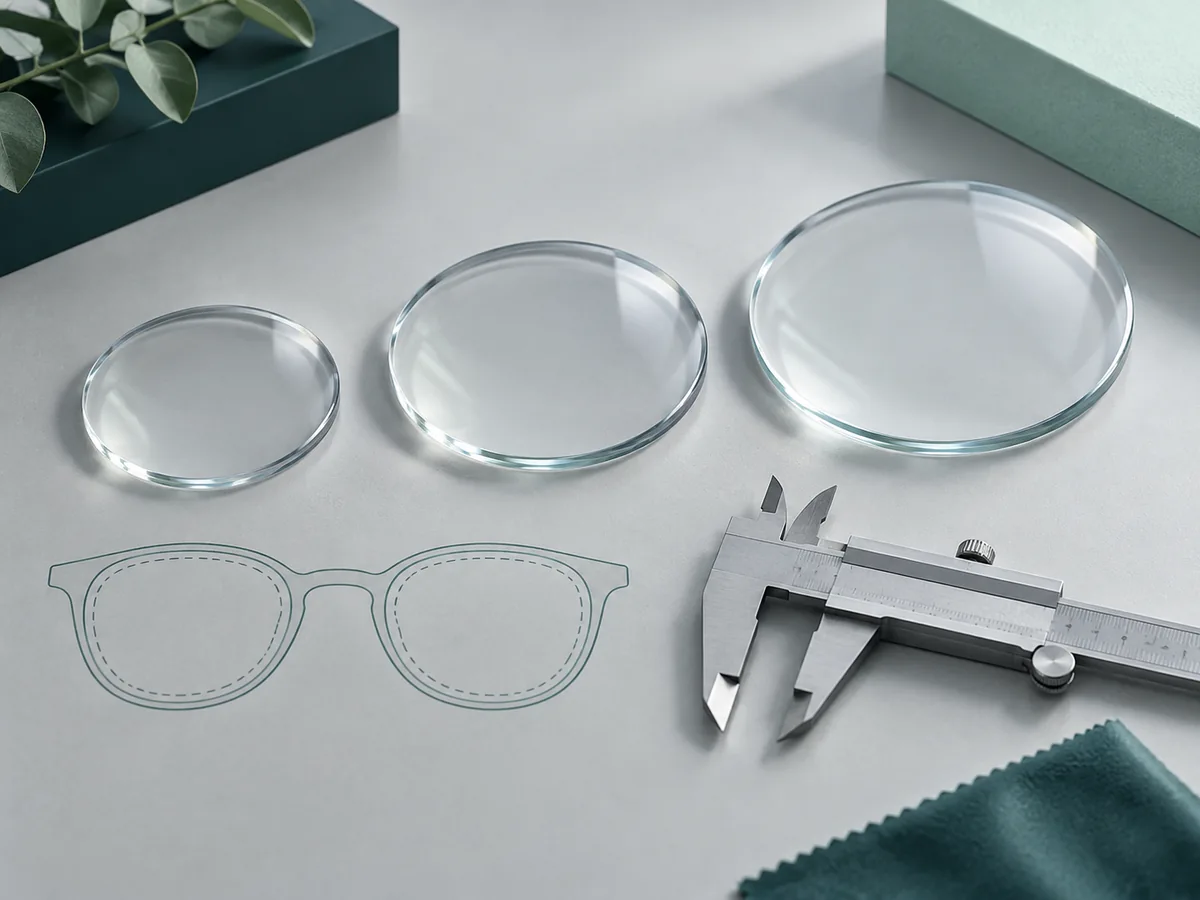
Choose lens diameter by checking whether the usable blank covers the traced frame after the required centration. A 75 mm blank provides more geometric room than a 65 mm blank, but it is not automatically the best order choice. Available powers, finished thickness and processing requirements still need confirmation. For a distributor, the useful deliverable is an approved diameter-by-power matrix rather than one diameter for every frame.
Key takeaways
- Use the actual frame trace and centration data for cutout approval.
- Confirm usable diameter, not only the nominal number on an envelope.
- Keep diameter and power linked in your purchasing spreadsheet.
What does the diameter on a lens envelope mean?
The diameter describes the uncut blank before edging. It does not describe the final width of a lens fitted into a frame. Ask whether the stated value is nominal and what usable area is guaranteed, including any edge exclusions or manufacturing allowances.
Frame fitting also depends on the position of the optical reference points. ZEISS explains why existing lenses cannot simply be transferred to any new frame. This is useful background for treating diameter as one part of a fit assessment.
Reference: ZEISS: Reusing lenses in a different frame
Compare the choices against the job
The following is a procurement decision table, not a promise that each diameter is available in every material or power. A supplier's confirmed range and the receiving laboratory's cutout check take priority.
| Nominal diameter | Question to resolve | Evidence to keep |
|---|---|---|
| 65 mm | Does the blank contain this frame trace after centration? | Approved cutout for the selected job |
| 70 mm | Does the additional margin solve the actual fit issue? | Trace, optical reference position and usable diameter |
| 75 mm | Is the larger blank available in the required power and coating? | Confirmed SKU and processing assessment |
An example of a useful cutout request
Suppose a buyer is comparing 70 and 75 mm stock blanks for a new frame collection. Send the laboratory the digital traces, prescription examples, required centration and intended processing route. Ask it to identify which jobs fit each blank and which require a different supply route. These are illustrative choices, not validated production dimensions.
Do not approve the entire collection because one sample frame works. Include a wider shape and a job with greater decentration. Record any exclusions so sales staff do not promise a combination that the laboratory has not checked.
- Frame model and trace revision
- Prescription and centration inputs
- Material, design and coating
- Usable diameter and approved exceptions
What should appear on the purchase order?
Give diameter its own column beside sphere, cylinder, material and coating. If substitution is allowed, describe who can approve it and whether price or thickness must be reviewed. An instruction such as 'send the nearest available size' leaves too much room for an unusable substitution.
During sample approval, check labels against the measured blank and retain the approved cutout record. Reopen the approval when the frame, optical design or material changes; a previous acceptance does not validate a different combination.
Buyer questions
Frequently asked questions
Is 75 mm always better than 70 mm?
No. It offers more geometric room, but the correct choice depends on cutout, power availability, processing and cost.
Can diameter be chosen from sphere power alone?
No. The frame trace, centration and full lens specification are also needed.
Can we mix diameters in a stock order?
Request a diameter-by-power matrix and separate quantities for each approved combination. Confirm the supplier's available range before ordering.
Further reading
These external references provide background context. Product availability and performance claims must still be confirmed for the exact item being purchased.