
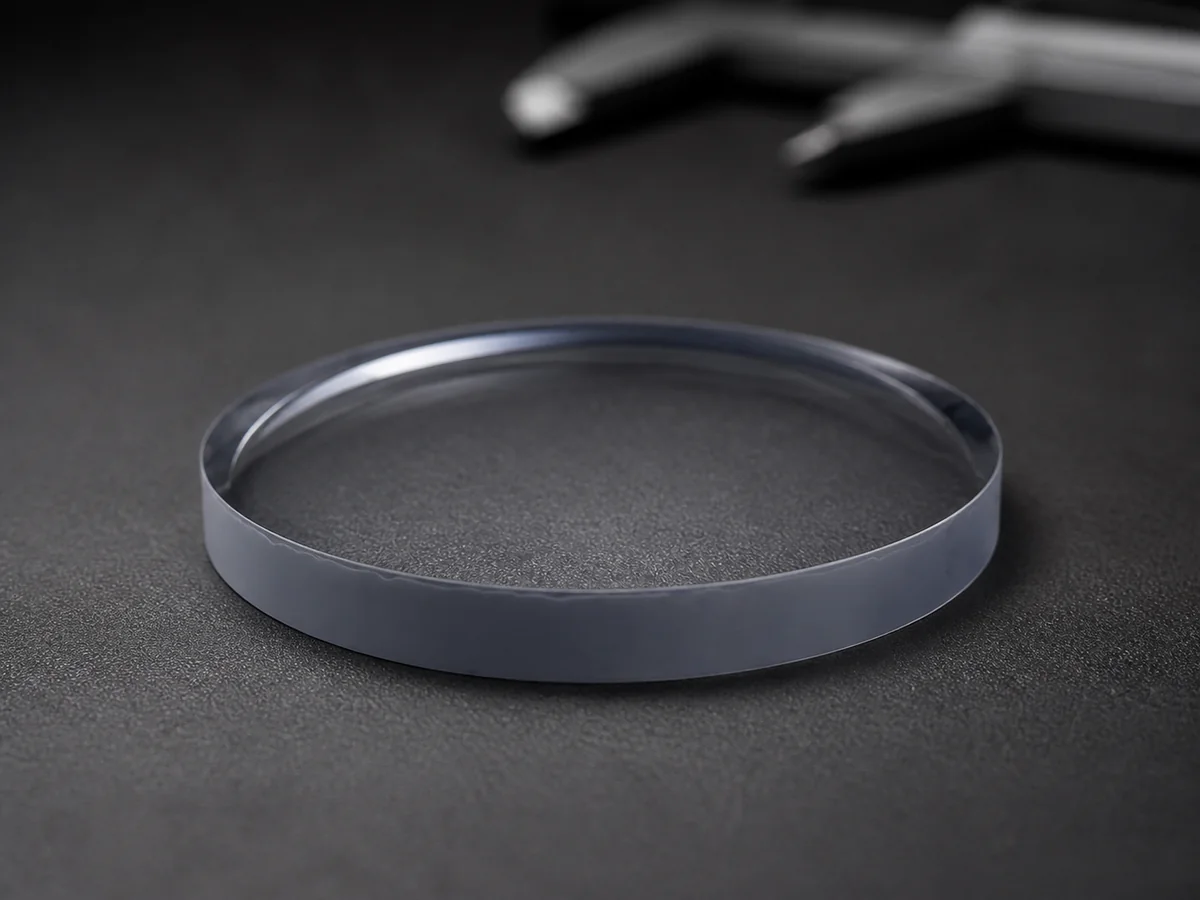
Finished and semi-finished lenses are different supply formats. A finished uncut lens already carries its final optical powers and normally needs only verification, edging, and fitting. A semi-finished blank has one prepared surface and leaves the other surface for laboratory surfacing. The right choice depends on whether the buyer needs a repeatable stock program or a flexible route for prescription and design customization.
Key takeaways
- Finished stock lenses are ordered by final sphere, cylinder, diameter, material, design, and coating.
- Semi-finished blanks require compatible surfacing capability, base-curve selection, and a defined laboratory process.
- Semi-finished does not mean lower quality; it describes the stage at which the lens enters the laboratory.
- Keep finished and semi-finished items in separate quotation and inventory matrices.
What changes between the two supply formats
A finished uncut lens has its final optical and geometrical properties before edging. Finished single-vision lenses are commonly supplied as stock items in defined powers and diameters. This makes them practical for high-volume, repeatable prescriptions when the available matrix matches the buyer's market.
A semi-finished blank is intentionally thicker. One surface, commonly the front, is already formed, while the laboratory generates and polishes the other surface to create the required prescription or design. The blank is therefore an input for lens manufacturing rather than a ready-to-edge prescription lens.
Operational comparison
The purchasing decision should reflect the buyer's equipment, order mix, and responsibility for the finished optical result.
| Supply format | Work remaining | Best suited to | Key buying controls |
|---|---|---|---|
| Finished uncut lens | Inspection, edging, and mounting | Standard powers and repeat stock programs | Power matrix, diameter, design, coating, tolerances |
| Semi-finished blank | Surfacing, polishing, coating as specified, edging | RX, freeform, multifocal, or laboratory-led programs | Base curve, diameter, front design, thickness, material, surfacing compatibility |
What to specify for semi-finished blanks
A blank cannot be qualified from index and diameter alone. Its front surface and physical geometry determine what the laboratory can produce from it.
- Material and refractive index
- Nominal diameter and center or edge thickness
- Base-curve range and front-surface design
- Single-vision, bifocal, progressive, or other intended route
- Clear, photochromic, polarized, tinted, or blue-filter construction
- Uncoated, hard-coated, or other front-surface condition
- Compatible power and design calculation range
- Packaging, traceability, and blank identification
How to approve the supply route
For finished lenses, inspect representative powers from the low, medium, and high parts of the matrix. Verify power, cylinder, axis where applicable, diameter, thickness, surface quality, coating appearance, and labels.
For semi-finished blanks, run a controlled laboratory trial. Record the selected base curve, generated back surface, blocking and polishing process, final power, thickness, cosmetics, and coating result. Repeat-order approval should refer to the blank specification and the validated process, not only to a sample photograph.
Buyer questions
Frequently asked questions
Can a semi-finished blank be edged directly into a frame?
No. It still requires laboratory surfacing and polishing to create the final optical prescription before edging.
Are finished lenses always single vision?
Finished stock supply is common for single-vision lenses, but the exact available designs vary. Confirm the supplier's finished-lens matrix rather than assuming.
Why are semi-finished blanks much thicker?
The extra material provides the allowance needed to generate the remaining optical surface and achieve the target prescription and thickness.
Further reading
These external references provide background context. Product availability and performance claims must still be confirmed for the exact item being purchased.