
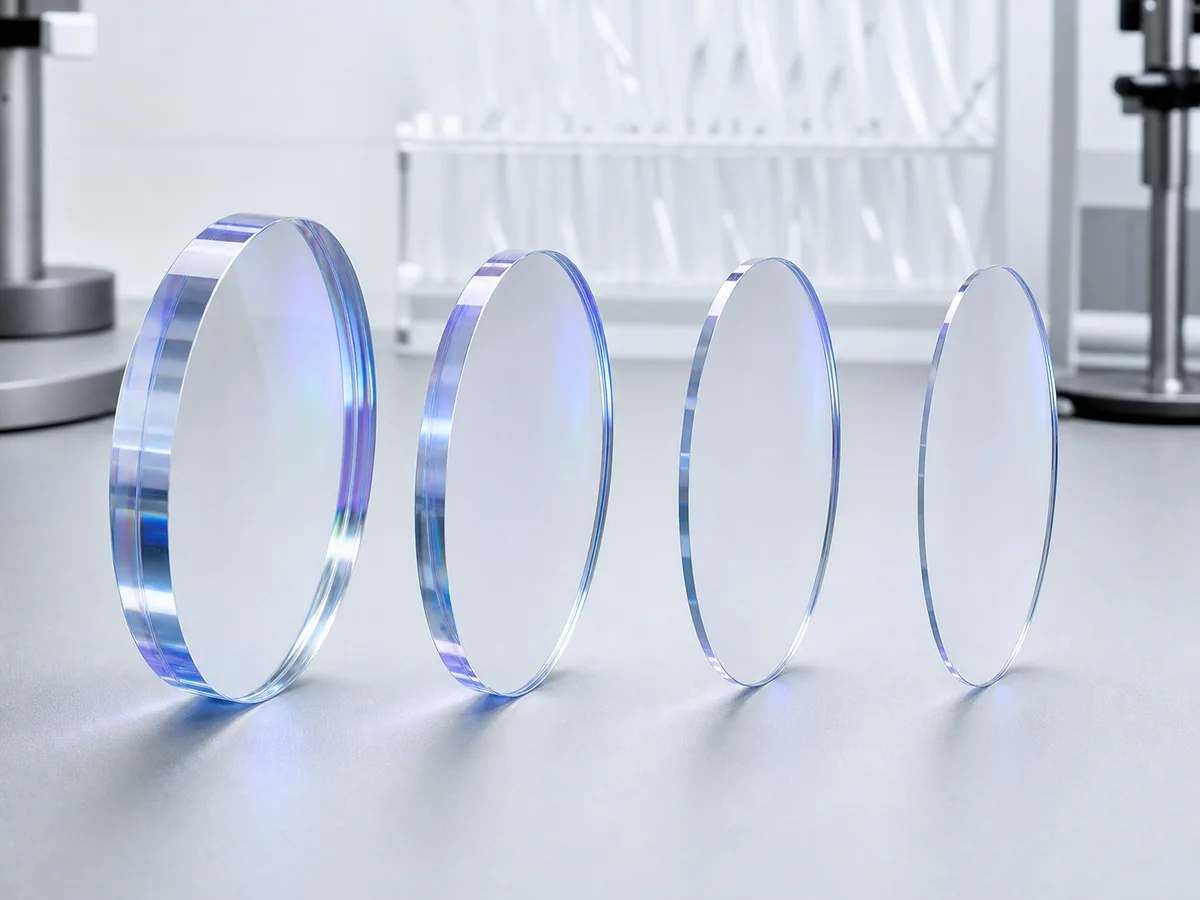
Refractive index tells you how strongly a lens material bends light. A higher index can achieve the same optical power with less curvature or material, which can help reduce finished thickness. For a wholesale buyer, however, index is only one part of the specification: prescription range, frame geometry, blank diameter, lens design, minimum thickness, coating, and price tier all affect the final result.
Key takeaways
- 1.56 is a practical standard-index program for broad everyday ranges.
- 1.60 is often positioned as a thinner step-up option for medium and selected higher powers.
- 1.67 is intended for thinner high-index programs, especially when prescription and frame conditions justify it.
- Never select index from prescription alone; confirm the full power-and-diameter matrix with the supplier.
What refractive index changes
The refractive index is a material property. As the index increases, less lens curvature is generally required to produce a given corrective power. This creates the potential for a flatter and thinner lens, particularly for stronger prescriptions.
It does not guarantee one fixed percentage of thickness reduction. Final edge or center thickness depends on power, cylinder, diameter, decentration, frame shape, base curve, lens design, and the laboratory's minimum-thickness rules. Published thickness comparisons from branded manufacturers apply to their own products and calculation conditions, so they should not be copied directly into a generic purchasing specification.
Practical comparison for a wholesale range
Use index tiers to build a clear good-better-best product structure, then confirm which powers and diameters are actually available in each material.
| Index | Typical position | Purchasing advantage | Points to confirm |
|---|---|---|---|
| 1.56 | Standard everyday range | Broad availability and accessible price positioning | Spherical or aspheric design, diameter, power matrix, coating |
| 1.60 | Mid/high-index upgrade | Thinner profile for selected medium and higher prescriptions | Exact substrate, Abbe value, design, power and cylinder limits |
| 1.67 | High-index thin-lens tier | Reduced thickness potential for stronger prescriptions | Design, minimum thickness, diameter, coating compatibility, price tier |
Why diameter and frame data matter
A large uncut blank gives more edging allowance, but it can also increase edge thickness for minus lenses if the finished lens must be cut far from its optical center. A smaller, well-selected diameter may produce a better result when it still covers the frame shape and decentration requirement.
For meaningful thickness comparisons, send the frame shape or box measurements, pupillary distance, fitting data, prescription range, and required minimum finished diameter. Comparing loose samples of different diameters does not provide a controlled index comparison.
Build the quotation around a matrix
A useful wholesale quotation should not say only '1.60 lens'. It should define the complete program so that the sample and repeat order refer to the same configuration.
- Finished stock lens or Rx/freeform supply route
- Sphere, cylinder, and add-power range where applicable
- Available diameter for each power band
- Spherical, aspheric, or other lens design
- Clear, blue-filter, photochromic, polarized, or tinted material route
- UC, HC, HMC, or buyer-defined coating specification
- Minimum center or edge thickness and cosmetic requirements
- Envelope label, packing quantity, and sample approval reference
Recommended sample comparison
Select representative low, medium, and high powers instead of ordering only plano samples. Keep diameter, design, frame data, and coating as consistent as possible. Check optical power, center location, diameter, thickness, surface quality, coating appearance, and label accuracy.
The approved sample should be tied to a written specification. This is more useful for repeat orders than relying on an index name or a supplier's marketing description.
Buyer questions
Frequently asked questions
Does a higher lens index always mean a thinner finished lens?
No. It creates thinner-lens potential, but the result also depends on prescription, diameter, decentration, frame shape, lens design, and minimum-thickness settings.
Is 1.67 suitable for every prescription?
Not automatically. For lower powers, the added cost may provide little visible benefit. Build the index recommendation around prescription and frame conditions.
Can 1.56, 1.60, and 1.67 use the same coating?
Coating names may be similar, but process availability and performance can vary by substrate. Confirm the coating route for each material and power matrix.
Further reading
These external references provide background context. Product availability and performance claims must still be confirmed for the exact item being purchased.